by Sharon Watson | Oct 15, 2017 | High School Prompts, High School Tutorial, Middle School Prompts, Middle School Tutorial, Sharon's Blog, teaching aids, tutorial
SHARON’S BLOG
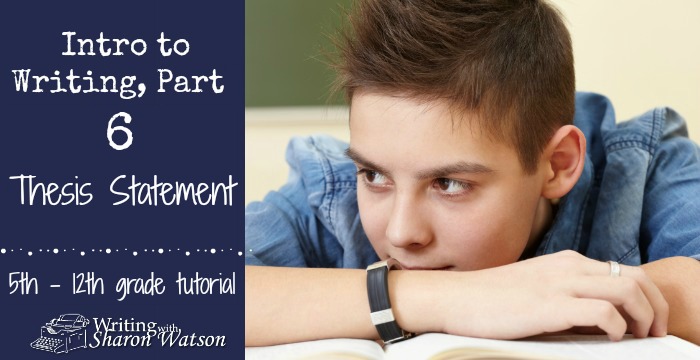
Thesis Statements
A guy walks in to your living room and blurts out, “Pizza.”
You look at him and wonder what he means. Well, you know the subject matter—pizza—but you don’t know where he’s going with this. He could take it in any of these directions:
“I want pizza.”
“Pizza is bad for you and here’s why.”
“Eat more pizza; it contains all the food groups.”
“I know how to get bigger tips working as a pizza delivery person.”
“This is how to build the perfect pizza.”
“The pizza you buy here is very different from the pizza you can get in Italy.”
“With six hundred dollars borrowed from their mother, two brothers began one humble Pizza Hut, now an international chain.”
Or, of course, he could mean, “Here’s the pizza you ordered. Now give me a tip so I can get out of here.”
When you write an essay, writing about the subject matter is only the beginning. Readers need to know what direction you are taking your subject. That way, they will keep reading and will understand what you are doing. For instance, if your introduction looks like you are going to write about the founder of Amazon but you end up writing about all the cool stuff you can find there, your readers will be confused.
What’s your main idea? What’s the one thought you want to convey to your readers? Everything you write about your subject matter is going to be gathered around one statement, one main idea, so that people reading your essay know what direction you are taking your subject.
This main idea is called a thesis statement. (more…)
by Sharon Watson | Oct 8, 2017 | High School Prompts, High School Tutorial, Middle School Prompts, Middle School Tutorial, Sharon's Blog, teaching aids, tutorial
SHARON’S BLOG
Problems with Point Orders?
One of my students handed in an interesting essay on volcanic activity. She included lots of facts, dates, and anecdotes, but there was one big problem.
There was no rhyme or reason for the order in which she put her facts. Each major or historic volcanic eruption was in its own paragraph, but the paragraphs were in no particular order. It felt jumbled and incoherent.
How could she have arranged her paragraphs to have the most impact on her reader? Check below for two possible answers to this conundrum. (more…)
by Sharon Watson | Oct 1, 2017 | High School Prompts, High School Tutorial, Middle School Prompts, Middle School Tutorial, Sharon's Blog, teaching aids, tutorial
SHARON’S BLOG
Can a chart rescue poorly written paragraphs?
Do your students have trouble coming up with ideas to put in their paragraphs? Are their paragraphs only one or two sentences long?
Are they a jumbled mess of ideas?
A paragraph is all about one idea. In it, your student will teach something about that idea, explain it, or prove why it is the right one.
In Intro to Writing, Part 4, you’ll find a practical chart to help your student formulate ideas and put them into a credible paragraph. (more…)
by Sharon Watson | Sep 24, 2017 | High School Prompts, High School Tutorial, Middle School Prompts, Middle School Tutorial, Sharon's Blog, teaching aids, tutorial
SHARON’S BLOG
Outlines.
Did I lose you already?
The idea of outlines and actually creating them can be confusing and frustrating to our students.
But what if we could make organizing material a little easier for them?
Intro to Writing, Part 3 takes some of the pain out of learning about outline. It uses material your students are already very familiar with: restaurant categories and the way grocery stores are organized. (more…)
by Sharon Watson | Aug 24, 2017 | Sharon's Blog
SHARON’S BLOG
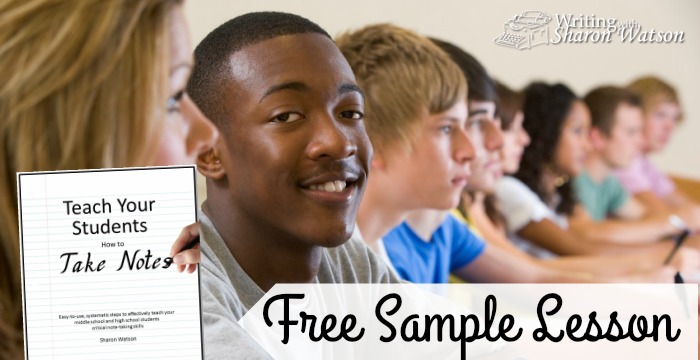
Are you worried that your students won’t be able to take notes in classes? Would you like to sharpen their listening skills?
Teach Your Students How to Take Notes, our most popular eBook, provides you with easy-to-use lessons for seven weeks, incrementally teaching your students how to take notes from auditory sources. Students will also learn to recognize important concepts and draw conclusions from oral and written sources.
Includes ALL the paragraphs, essays, and colorful note-taking pages you need.
Bonuses: (more…)