by Sharon Watson | May 3, 2015 | High School Prompts, Sharon's Blog, Writing Prompts
HIGH SCHOOL PROMPTS
So you’re driving your taxi, and someone hails you from the sidewalk. In comes a man you eventually recognize, and you get so excited that you shout a phrase from one of his movies to him.
He laughs and joins in the fun. You drop him off, but that is not the end of the story.
Later, he sends you tickets to his latest Broadway show, and you go and even get to meet with him after the show in his dressing room!
You can read the whole, fun story about the taxi driver “Mr. Ferrari” and the famous actor (more…)
by Sharon Watson | May 2, 2015 | High School Prompts, High School Tutorial, Sharon's Blog, teaching aids, tutorial
SHARON’S BLOG
Here’s a free grammar lesson for your teens from The Power in Your Hands: Writing Nonfiction in High School, 2nd Edition. It’s on gender-neutral language in writing—and it has the answers at the end! Keep reading to see this valuable lesson. Enjoy!
Incidentally, the subject of gender-neutral language is not related to the transgender movement or any biological issues.
(more…)

by Sharon Watson | Apr 26, 2015 | High School Prompts, High School Tutorial, Sharon's Blog, tutorial, Writing Prompts
HIGH SCHOOL PROMPTS
Today you get to be Shakespeare and write a sonnet.
A sonnet is a poem of fourteen lines. The last two lines, however, are separate and either sum up the rest of the poem or provide a new twist, as does the sonnet below.
Let’s look at Shakespeare’s Sonnet 62. The letters at the end of each line are Shakespeare’s rhyme scheme, but ignore that for now. Take a few moments and read the sonnet. Then I’ll explain it: (more…)

by Sharon Watson | Apr 19, 2015 | High School Prompts, High School Tutorial, Middle School Prompts, Middle School Tutorial, Sharon's Blog, teaching aids, tutorial, Writing Prompts
April is National Poetry Month. What a wonderful time to try your hand at writing a poem!
Haiku (high KOO) is a beautiful poem form that comes from Japan. It is usually about nature and can be spoken in one breath.
Syllables are important in a haiku. Words can be broken into parts based on their vowel sounds. Those parts are syllables. Tree has one syllable. Forest has two. And timberland has three. When you speak these words out loud, you can hear their syllables.
Haiku poems have another feature: They do not rhyme. (more…)
by Sharon Watson | Apr 12, 2015 | High School Prompts, Sharon's Blog, Writing Prompts
HIGH SCHOOL PROMPTS
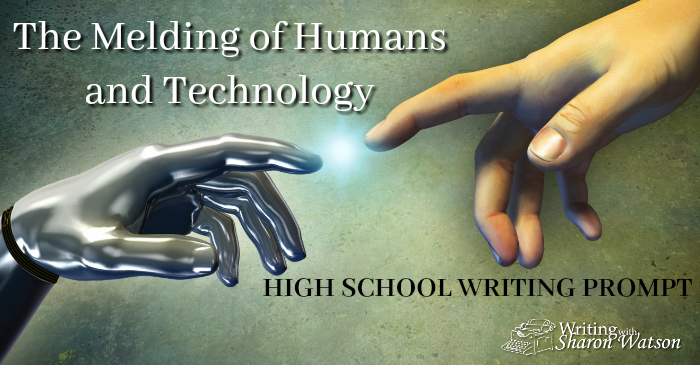
“Within 30 years, we will have the means to create superhuman intelligence. Shortly after, the human era will be ended.” -Vernor Vinge, in “The Coming Technological Singularity”
Raymond Kurzweil, a futurist, inventor, and author of books on artificial intelligence, believes that “we’re approaching a moment when computers will become intelligent, and not just intelligent but more intelligent than humans. When that happens, humanity—our bodies, our minds, our civilization—will be completely and irreversibly transformed…. Maybe we’ll merge with [the superintelligent computers] to become superintelligent cyborgs, using computers to extend our intellectual abilities the same way that cars and planes extend our physical abilities.” * (more…)

by Sharon Watson | Apr 5, 2015 | High School Prompts, Sharon's Blog, Writing Prompts
HIGH SCHOOL PROMPTS
Is physical perfection possible?
If it is, do we really want it?
And if it isn’t, should we pretend to be perfect?
These are some of the questions teen Haleigh Hohman asks in her Facebook video after finding a very interesting button on her new phone that she calls the “magic button.” (more…)