by Sharon Watson | Oct 28, 2014 | High School Prompts, High School Tutorial, Middle School Prompts, Middle School Tutorial, Sharon's Blog, teaching aids, tutorial, Writing Prompts
SHARON’S BLOG
You may be very good at expressing your opinions, especially when you want to change someone’s mind.
What you may not know is that if you truly want to change someone’s mind, you have to stop thinking about your opinion and start thinking about your audience.
This tutorial, with a free infographic to download, will show you very clearly the difference between writing an opinion and writing to persuade an audience.
Opinion versus Persuasion
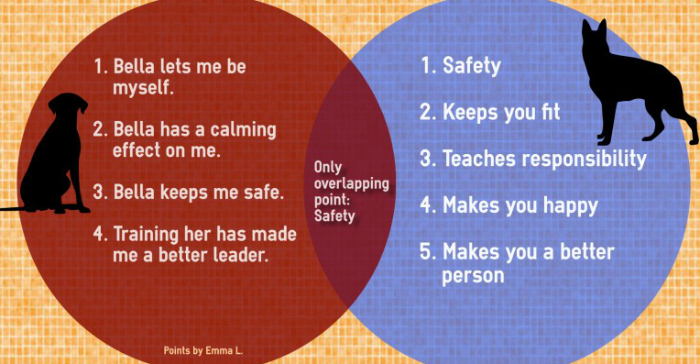
Writing or expressing an opinion is all about what you like; convincing another person to do something is all about what they need to hear to be persuaded.
Here’s an infographic that shows the difference between writing an opinion and writing to persuade. After the infographic, I’ve included a short writing exercise you can do quickly. My writing class just did it, and they had fun sharing their ideas about alligators, snow leopards, snakes, and so forth. (more…)

by Sharon Watson | Oct 19, 2014 | High School Prompts, High School Tutorial, Sharon's Blog, teaching aids, tutorial, Writing Prompts
HIGH SCHOOL PROMPTS
Hyperbole is a lot of fun to read and to write.
But what is it?
Hyperbole (hi PER bo lee) is exaggeration, as in “He was as hefty as a whale” or “Her whining voice so electrified the air that it knocked migrating geese off their course.” To read examples of this figure of speech, click here.
Just so you know, this figure of speech is also called a writer’s device and a literary device. And, just so you also know, “writer’s device” and “literary device” mean the same thing. The first is from the writer’s perspective; the latter is from the perspective of a student studying literature.
Here’s an example of hyperbole from Lee Child’s Personal in which he describes one of the bad guys: (more…)

by Sharon Watson | Oct 12, 2014 | High School Prompts, High School Tutorial, Middle School Prompts, Middle School Tutorial, Sharon's Blog, tutorial, Writing Prompts
HIGH SCHOOL PROMPTS
How do you write a story about Alaska before people arrived? You make animals the main characters, which is exactly what James A. Michener does in Alaska.
Michener creates Matriarch, a mammoth that is old enough to be the grandmother of many other mammoths. Through her eyes, we see the landscape and experience the early troubles of the area now known as Alaska.
An Alaskan Matriarch
Here’s a passage from Alaska in which Matriarch first encounters . . . well, I think you’ll figure out what’s going on here: (more…)
by Sharon Watson | Oct 7, 2014 | High School Prompts, High School Tutorial, Middle School Prompts, Middle School Tutorial, Sharon's Blog, tutorial, Writing Prompts
SHARON’S BLOG
Let’s celebrate Hispanic Heritage Month by highlighting a short story by Colombian-born Gabriel García Márquez.
Many stories can be put into one of two categories when talking about how the ball gets rolling: (more…)
by Sharon Watson | Sep 23, 2014 | High School Prompts, High School Tutorial, Middle School Prompts, Middle School Tutorial, Sharon's Blog, teaching aids, tutorial
SHARON’S BLOG
 Do your students waste endless time erasing whole sentences? Do they become discouraged when they look at their rough drafts filled with arrows, illegible notes in the margins, and ugly lines of scratched-out writing?
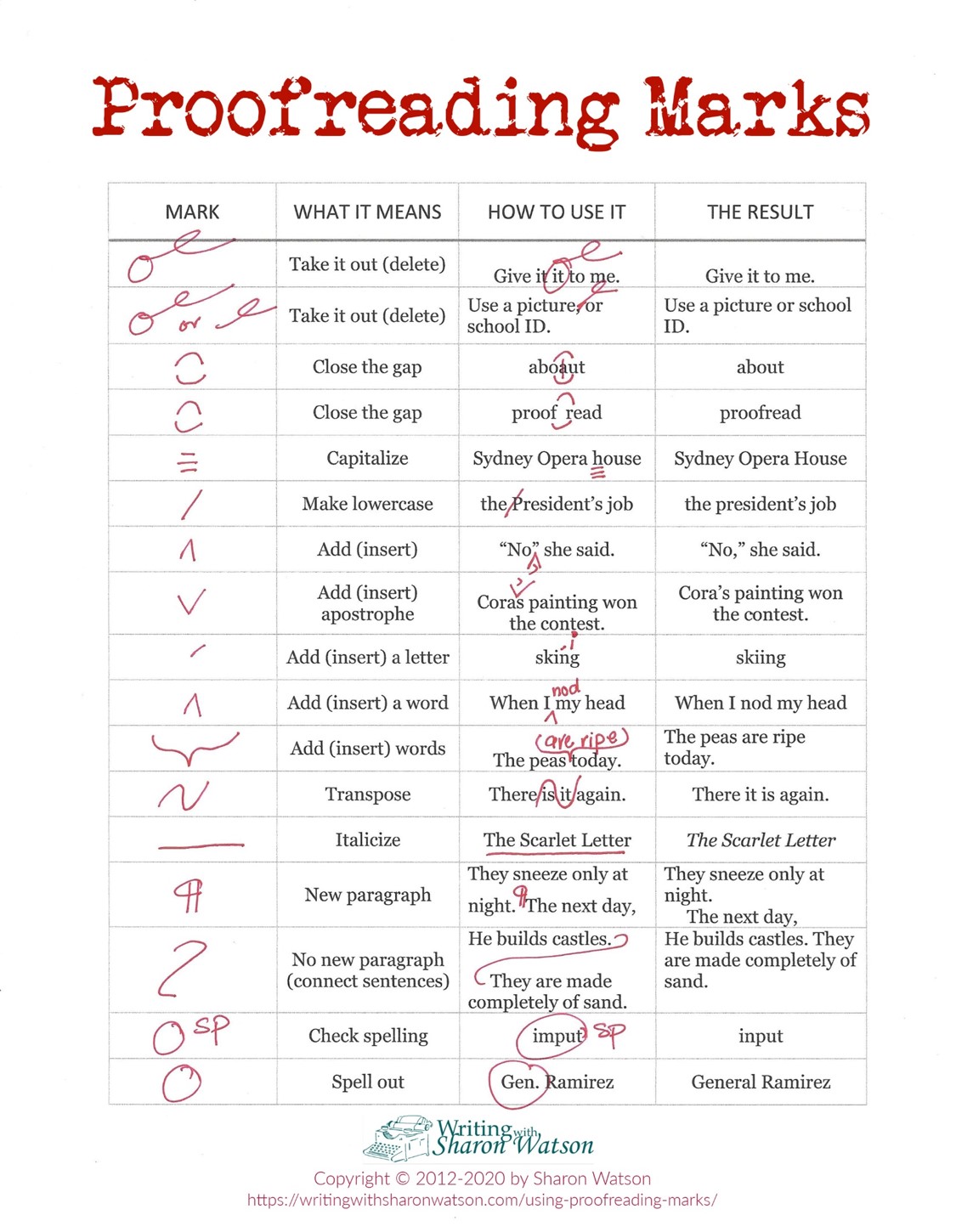
Let’s save them the pain by teaching them these handy, easy-to-use proofreading marks.
I’ve watched students in my writing classes scratch out whole sentences and rewrite them. They draw lines through words. They burn up their papers and crumble their erasers just to change something.
This is totally unnecessary.
There’s an easier—and quicker—way to proofread that doesn’t require a lot of rewriting, which should be good news to our students.
But first, the other grammar tutorials
This is the last in a series of tutorials on grammar. In this one, you and your students will learn how to use these helpful proofreading marks.
If you’re dying to know what the other grammar tutorials are about, click here for one on punctuation in dialog. (Tarzan and Jane help out on that one.) Click here if you yearn to know how to handle commas in compound sentences with coordinating conjunctions.
And click here for the hard-hitting exposé on where to put the comma, period, colon, or semicolon when using quotation marks. Here’s a tutorial on a question I suspect you’ve heard from your students about using question marks and exclamation points with end quotation marks (you know, do they go inside or outside?).
For the tutorial revealing the crazy fact that the word “everyone” is singular, click here. And to finally put to rest your students’ confusion about it’s/its, you’re/your, and others of that ilk, click here.
Proofreading Marks
As with all the other tutorials, you get a super-duper package today: an infographic to teach the proofreading marks, an example of how to use them in a real paragraph, an exercise so students can fix someone else’s mistakes, and the answers. (more…)
by Sharon Watson | Sep 16, 2014 | High School Tutorial, Middle School Tutorial, Sharon's Blog, teaching aids, tutorial
SHARON’S BLOG
 This week’s grammar tutorial puts to rest some confusing words like “it’s” and “its.”
You can use the infographic below to teach your students about some confusing word usage. After that, there’s an exercise to reinforce the material with your students, and you’ll find the answers below the exercise.
Now, on to the tutorial . . . (more…)