by Sharon Watson | Jul 19, 2015 | High School Prompts, High School Tutorial, Sharon's Blog, teaching aids, tutorial, Writing Prompts
HIGH SCHOOL PROMPTS
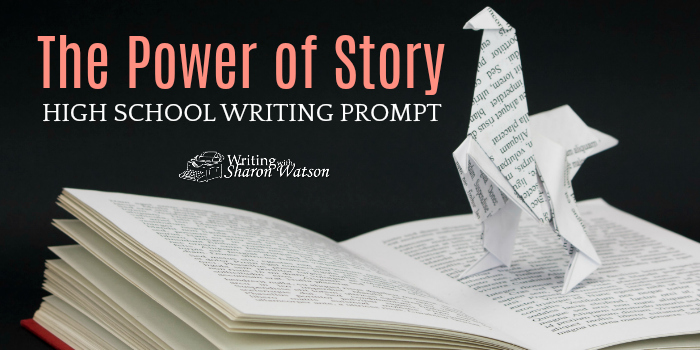
Do you want to influence your readers? Do you want to grab their hearts?
Use the power of story.
There are two kinds of stories: the true ones and the fictional ones. People have been using both kinds forever, and so can you.
(more…)
by Sharon Watson | Jun 20, 2015 | High School Prompts, High School Tutorial, Middle School Prompts, Middle School Tutorial, Sharon's Blog, tutorial, Writing Prompts
SHARON’S BLOG
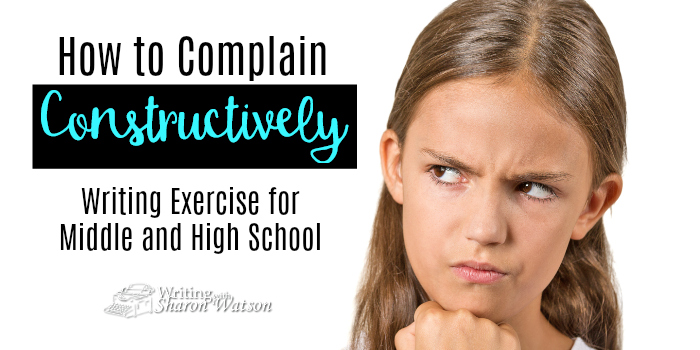
True story: I was eating dinner in a restaurant recently when I heard a woman in the booth behind me state, “This is an abomination!”
My ears perked up. My curiosity was piqued. I rarely hear the word “abomination” any more and wondered what could be so horrific as to need that word. I imagined she and her dining partner were reading a magazine article on human trafficking or perhaps watching a YouTube video about persecution in Indonesia.
I strained my ears to learn what she was referring to. (more…)

by Sharon Watson | Jun 7, 2015 | High School Prompts, High School Tutorial, Literature, Sharon's Blog, teaching aids, tutorial, Writing Prompts
HIGH SCHOOL PROMPTS
In a recent tutorial, you practiced plunging your character into hot water with two powerful methods many writers use. You can find that prompt here.
This week you’ll examine three more methods of getting your main character deep into a story. As Stanley Elkin reveals, “I would never write about someone who is not at the end of his rope.” (more…)

by Sharon Watson | May 31, 2015 | High School Prompts, High School Tutorial, Literature, Sharon's Blog, teaching aids, tutorial, Writing Prompts
HIGH SCHOOL PROMPTS
You have an idea for a story but don’t know how to get it going. Or you would like to write a story but are out of ideas.
When you write a story, you have to throw a lot of things at your main character, things he or she would rather not have to deal with. In this prompt, you’ll learn two proven methods to get ideas and plunge your character into hot water. In this prompt, you’ll explore three more. (more…)
by Sharon Watson | May 2, 2015 | High School Prompts, High School Tutorial, Sharon's Blog, teaching aids, tutorial
SHARON’S BLOG
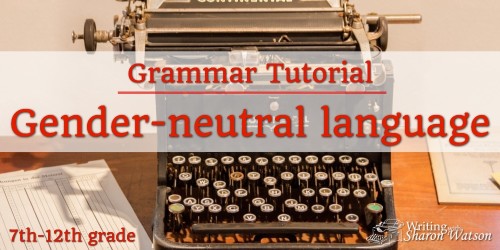
Here’s a free grammar lesson for your teens from The Power in Your Hands: Writing Nonfiction in High School, 2nd Edition. It’s on gender-neutral language in writing—and it has the answers at the end! Keep reading to see this valuable lesson. Enjoy!
Incidentally, the subject of gender-neutral language is not related to the transgender movement or any biological issues.
(more…)

by Sharon Watson | Apr 26, 2015 | High School Prompts, High School Tutorial, Sharon's Blog, tutorial, Writing Prompts
HIGH SCHOOL PROMPTS
Today you get to be Shakespeare and write a sonnet.
A sonnet is a poem of fourteen lines. The last two lines, however, are separate and either sum up the rest of the poem or provide a new twist, as does the sonnet below.
Let’s look at Shakespeare’s Sonnet 62. The letters at the end of each line are Shakespeare’s rhyme scheme, but ignore that for now. Take a few moments and read the sonnet. Then I’ll explain it: (more…)