by Sharon Watson | Mar 4, 2014 | Sharon's Blog, teaching aids, tutorial
SHARON’S BLOG
Your child has just handed you a completed essay, and you are ecstatic . . . until you realize you now have to grade it. Where do you begin? How do you evaluate this marvelous gift?
Grading Essays
Welcome to this exciting, first-in-a-series blog about grading your middle and high school students’ essays! You can find the whole video by clicking here.
Learn to ask six key questions of the paragraphs in the body of your students’ essays in this part-one tutorial. I’ll walk you through these questions from the obvious to the not-so-obvious. Keep reading to view the outline and quoted paragraphs from the tutorial.
What you’ll want to know: (more…)
by Sharon Watson | Feb 18, 2014 | Literature, Sharon's Blog, teaching aids
SHARON’S BLOG
Choosing a literature program for your teens isn’t the easiest thing in the world. Neither are actually having the class and getting teens to read the books. Are false ideas about literature sabotaging all of your good efforts?
Read on to see if you have avoided believing these three myths about homeschool literature. And before I forget, check out the link at the end of this article for your FREE downloads from our literature courses.
(more…)
by Sharon Watson | Feb 4, 2014 | High School Prompts, High School Tutorial, Middle School Prompts, Middle School Tutorial, Sharon's Blog, teaching aids, tutorial, Writing Prompts
SHARON’S BLOG
My husband Terry gave me the idea for this writing prompt though he didn’t know it at the time.
A love of lists
Last summer we drove to our local grocery store, and as Terry pulled into a spot, he said, “I like to park here because . . . ,” and he listed four reasons why he likes to park in that particular place. Now that you know how exciting our lives are, you’ll be happy to know that his love of lists surfaced yet again—at the ball park.
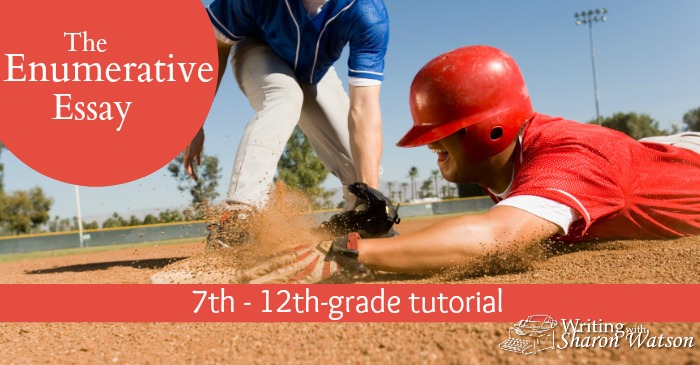
We were watching the Indianapolis Indians play the Rochester Redwings when one of the Indians smacked a ball and headed toward first. Terry leaned over to me and said, “There are nine ways to get to first safely.” Or was it seven?
Terry was halfway to writing an enumerative essay because he began with a number (four or nine) and had a secure idea of a list. (more…)
by Sharon Watson | Jan 22, 2014 | High School Prompts, High School Tutorial, Sharon's Blog, teaching aids, tutorial
SHARON’S BLOG
Proofreading is painful for students. They feel they’re through with the writing process when they write their first draft and then want nothing more to do with that essay. Students tell me that writing the first draft and proofreading it is like writing their paper twice.
.
However, the skill of proofreading their own papers is essential to the writing process.
Why proofread?
- First, by catching their mistakes or finessing the points or flow of the essay, students learn to write more effectively.
- Second, they show respect for their teachers by handing in a well-thought-out paper with few mistakes.
- And third, students begin to understand through the editing process that there is an audience at the other end of their essays. They aren’t writing simply to keep themselves busy; they are writing to communicate, educate, explain, persuade, or entertain.
.
What methods can we teach our students so they can proofread their work by themselves?
(more…)
by Sharon Watson | Jan 7, 2014 | Encouragement, Sharon's Blog, teaching aids
SHARON’S BLOG
 Some kids hate writing essays, and off the top of their heads they can give you 97 reasons why this is so.
When I teach my writing course locally, some students are bound to come to the first class with a “don’t even bother trying to teach me” attitude. They believe they are so far gone that they are unteachable.
I disagree. (more…)
by Sharon Watson | Jan 2, 2014 | Literature, Sharon's Blog, teaching aids
SHARON’S BLOG
Literature might seem like one of those courses in which pulling teeth is involved.
You assign a poem, play, short story, or novel to read, and you immediately encounter resistance. It’s hard, they say. It’s boring, they complain. The lawyer in them tries to make a deal with you: “I’ll read these more exciting young adult novels, and you can count that as literature. At least I’m reading.”
What can you do?
(more…)