by Sharon Watson | Apr 5, 2015 | Middle School Prompts, Middle School Tutorial, Sharon's Blog, teaching aids, tutorial, Writing Prompts
MIDDLE SCHOOL PROMPTS
Reading descriptions can be super boring; you probably skip them when you read older books, especially if they go on and on.
Today’s writers know how to capture your attention and keep the descriptions interesting. What are their secrets? We’ll explore two today.
Senses
First, they use their senses. Here’s a fascinating verse about Jesus that the apostle John writes in the beginning of his first letter:
“That which was from the beginning, which we have heard, which we have seen with our eyes, which we have looked at and our hands have touched—this we proclaim concerning the Word of life” (I John 1:1 NIV)
How many senses from the list below does he depend on to tell us that Jesus is real? (more…)

by Sharon Watson | Mar 22, 2015 | High School Prompts, High School Tutorial, Sharon's Blog, teaching aids, tutorial, Writing Prompts
SHARON’S BLOG
I love to bring you examples of effective writing so your students can use them, and Israeli Prime Minister Benjamin Netanyahu’s speech to a joint meeting of the U. S. Congress is an excellent example of persuasive writing. He used many powerful strategies in his speech, five of which we’ll delve into today.
Your students will better understand the intricacies of writing when they have the chance to learn from professional examples of published authors and speechmakers, so, to that end, let’s explore the persuasion tactics Netanyahu used.
Below are five powerful persuasion techniques. After the list, you’ll find a family writing prompt that involves one of them.
To read the complete transcript of Israeli Prime Minister Benjamin Netanyahu’s speech, click here. .
(more…)
by Sharon Watson | Mar 22, 2015 | High School Prompts, High School Tutorial, Middle School Prompts, Middle School Tutorial, Sharon's Blog, teaching aids, tutorial, Writing Prompts
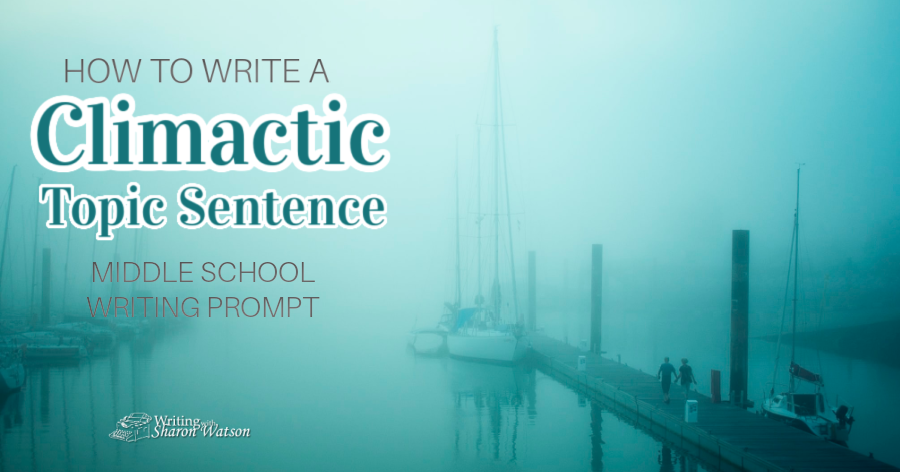
You are familiar with topic sentences, how they come at the beginning of paragraphs and tell readers what the paragraph is all about.
But what if the topic sentence came at the end of the paragraph? And what if that paragraph described something from a story?
Topic sentence at the end
Here’s part of a paragraph from J. R. R. Tolkien’s The Hobbit. Notice the topic sentence at the end of the description: (more…)

by Sharon Watson | Jan 25, 2015 | High School Prompts, High School Tutorial, Sharon's Blog, tutorial, Writing Prompts
HIGH SCHOOL PROMPTS
In a story, clothing can be the author’s way of telling us what kind of character we’re reading about.
What are they wearing?
Judging real people by their clothing might not be too smart, but authors rely on readers to judge characters based on their characters’ clothing.
For instance, someone in a black leather jacket with a skull embroidered on the back and chains hanging from a pants pocket is going to be very different from someone in a light aqua-colored jacket carrying an umbrella with pink flowers on it. We make assumptions of people according to their appearance. (more…)
by Sharon Watson | Nov 30, 2014 | High School Prompts, High School Tutorial, Sharon's Blog, teaching aids, tutorial, Writing Prompts
HIGH SCHOOL PROMPTS
 Although author Joseph Conrad was born in Poland as Józef Teodor Konrad Korzeniowski, he learned to speak and write in English in his twenties.
The fact that he learned how to write in the English language so late in life makes his command of the language, as seen in his stories, impressive.
Joseph Conrad is famous for his novella Heart of Darkness in which the narrator goes on a voyage to the jungles of Africa in the late 1800s in search of a man named Kurtz.
Below is the narrator’s description of a scene he comes upon. You can tell by the words and items he chooses in this description that what he finds next will not be nice: (more…)
by Sharon Watson | Nov 9, 2014 | Literature, Middle School Prompts, Middle School Tutorial, Sharon's Blog, teaching aids, tutorial, Writing Prompts
MIDDLE SCHOOL PROMPTS
This is a good time of year to read James Whitcomb Riley’s “When the Frost Is on the Punkin,” which you can read here. It describes the glories of life on the farm during the cool, crisp days of autumn, and the harvest season.
In the poem, you’ll find this phrase: “The husky, rusty russel of the tossels of the corn / And the raspin’ of the tangled leaves as golden as the morn. . .”
Note: Riley misspells “russel” on purpose. The correct spelling is “rustle.” Same with “tossels,” which is supposed to be “tassels.” And, of course “punkin,” which is, you guessed it, “pumpkin.” He’s using a country dialect in his writing.
Riley uses the three wonderful words “husky, rusty russel” to describe the sound of the dried leaves of the corn plant as they rub together in the wind. If you have ever heard those dry leaves or blades rubbing together, you can almost hear the “s” sound in the wind, as though they are whispering to each other.
What are Riley’s secrets to writing so well? (more…)