by Sharon Watson | Sep 23, 2014 | High School Prompts, High School Tutorial, Middle School Prompts, Middle School Tutorial, Sharon's Blog, teaching aids, tutorial
SHARON’S BLOG
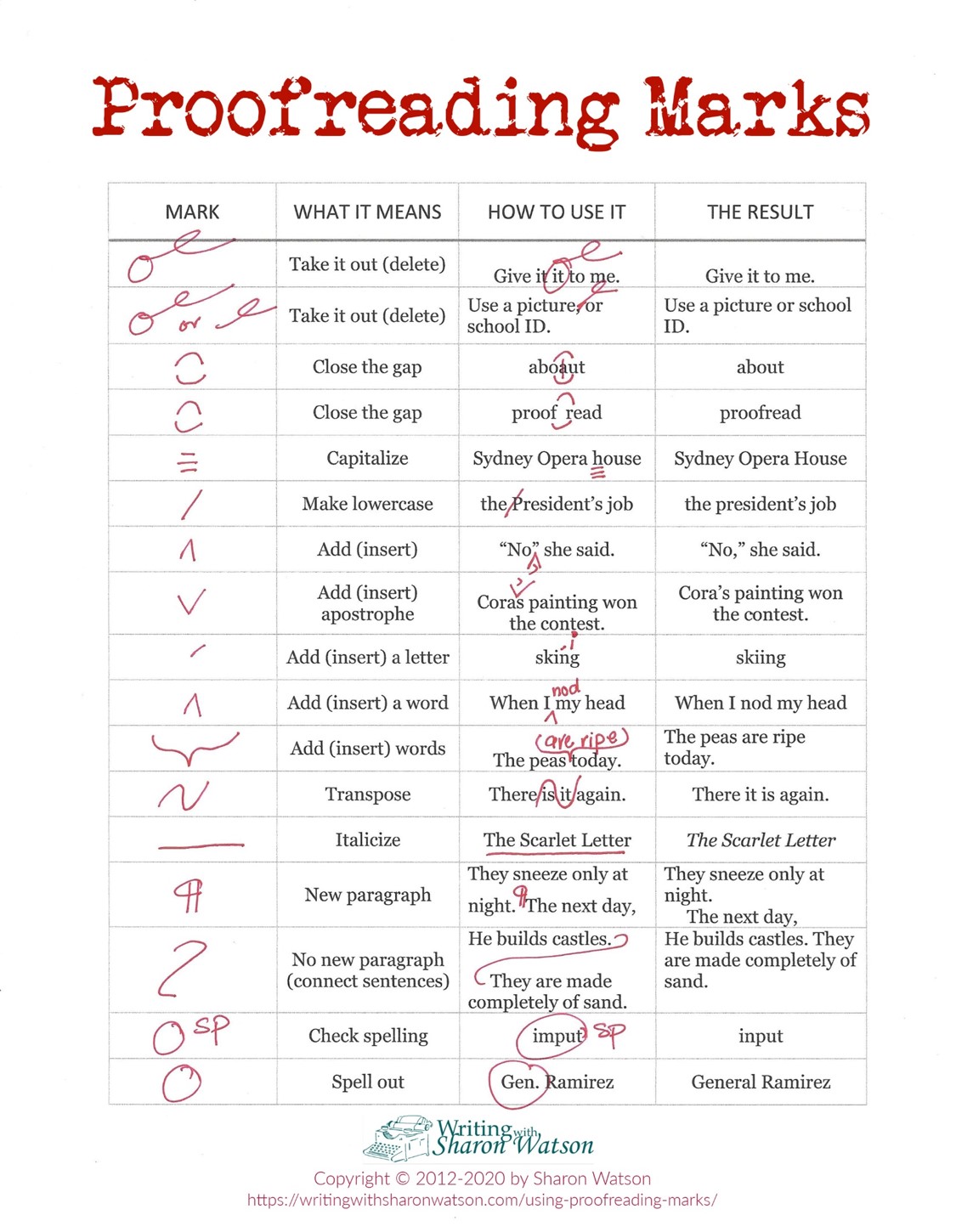
 Do your students waste endless time erasing whole sentences? Do they become discouraged when they look at their rough drafts filled with arrows, illegible notes in the margins, and ugly lines of scratched-out writing?
Let’s save them the pain by teaching them these handy, easy-to-use proofreading marks.
I’ve watched students in my writing classes scratch out whole sentences and rewrite them. They draw lines through words. They burn up their papers and crumble their erasers just to change something.
This is totally unnecessary.
There’s an easier—and quicker—way to proofread that doesn’t require a lot of rewriting, which should be good news to our students.
But first, the other grammar tutorials
This is the last in a series of tutorials on grammar. In this one, you and your students will learn how to use these helpful proofreading marks.
If you’re dying to know what the other grammar tutorials are about, click here for one on punctuation in dialog. (Tarzan and Jane help out on that one.) Click here if you yearn to know how to handle commas in compound sentences with coordinating conjunctions.
And click here for the hard-hitting exposé on where to put the comma, period, colon, or semicolon when using quotation marks. Here’s a tutorial on a question I suspect you’ve heard from your students about using question marks and exclamation points with end quotation marks (you know, do they go inside or outside?).
For the tutorial revealing the crazy fact that the word “everyone” is singular, click here. And to finally put to rest your students’ confusion about it’s/its, you’re/your, and others of that ilk, click here.
Proofreading Marks
As with all the other tutorials, you get a super-duper package today: an infographic to teach the proofreading marks, an example of how to use them in a real paragraph, an exercise so students can fix someone else’s mistakes, and the answers. (more…)
by Sharon Watson | Sep 16, 2014 | High School Tutorial, Middle School Tutorial, Sharon's Blog, teaching aids, tutorial
SHARON’S BLOG
 This week’s grammar tutorial puts to rest some confusing words like “it’s” and “its.”
You can use the infographic below to teach your students about some confusing word usage. After that, there’s an exercise to reinforce the material with your students, and you’ll find the answers below the exercise.
Now, on to the tutorial . . . (more…)

by Sharon Watson | Sep 14, 2014 | High School Prompts, High School Tutorial, Middle School Prompts, Middle School Tutorial, Sharon's Blog, teaching aids, tutorial, Writing Prompts
Do you have to write an essay?
Are you stuck for ideas?
Have no fear. Here’s a strange way to get ideas for essays: Use your initials. (more…)
by Sharon Watson | Sep 9, 2014 | High School Tutorial, Middle School Tutorial, Proofreading Tips, Sharon's Blog, teaching aids, tutorial
SHARON’S BLOG
 It is hard to believe, but the word “everyone” is singular.
It sounds as though it should include a lot of people; in fact, it should include everyone—and that sounds plural.
But “everyone” is in the list of singular indefinite pronouns, which are listed here: each, every, either, neither, no, one, no one, everyone, someone, anyone, nobody, everybody, somebody, anybody, nothing, everything, something, anything.
I grouped them by their endings: -one, -body, and -thing. You also could list most of them by their beginnings: no-, every-, some-, and any-.
This week’s blog, which is another in a series of grammar tutorials, includes the following:
- An infographic to teach the material
- An exercise for your students
- Answers to the exercise (more…)
by Sharon Watson | Sep 1, 2014 | High School Tutorial, Middle School Tutorial, Sharon's Blog, teaching aids, tutorial
SHARON’S BLOG
 Welcome to yet another of biting, incisive grammar question like this one: “Mom, is this sentence supposed to have one question mark or two at the end?”
Other grammar tutorials
If you’re dying to know what the other grammar tutorials are about, click here for one on punctuation in dialog. (Tarzan and Jane help out on that one.)
Click here if you yearn to know how to handle commas in compound sentences with coordinating conjunctions.
And click here for the hard-hitting exposé on where to put the comma, period, colon, or semicolon when using quotation marks.
End Punctuation
I’m fully aware that the heading “End Punctuation” could be the heart’s cry of your struggling students.
However, this week, your students will wrestle with the thorny problem of what to do if a sentence is a question (interrogative) but there’s already a question mark to the left of the end quotation mark.
Take a look at the infographic, which is the lesson. (more…)
by Sharon Watson | Aug 26, 2014 | High School Tutorial, Literature, Middle School Tutorial, Sharon's Blog, teaching aids, tutorial
SHARON’S BLOG
 Welcome to the third in a series of grammar tutorials! You can find the first one on commas in compound sentences here.
The second one teaches the position of commas, periods, colons, and semicolons when used with quotation marks. What could be more exciting?!
Dialog punctuation tutorial
Do you have students who love to hide in their bedrooms and write story after story?
Most likely, they are hoping to be published one day, their stories read and loved by millions, their names on the covers of sought-after books.
One thing editors look for in a new writer is proficiency in grammar and punctuation. Granted, it’s not a huge thing; it’s more important to know how to write a great story. But grammar is an indicator of how well the writer knows the language and its conventions, and it is something that editors take into account when determining whom to publish.
Let’s make sure our students have access to the skills they need to get published.
A tiff between Tarzan and Jane in this fun tutorial will guide your students through the punctuation-in-dialog jungle. (more…)