by Sharon Watson | Oct 11, 2015 | High School Prompts, High School Tutorial, Literature, Sharon's Blog, teaching aids, tutorial, Writing Prompts
HIGH SCHOOL PROMPTS
“You can never cross the ocean until you have the courage
to lose sight of the shore.” –Christopher Columbus
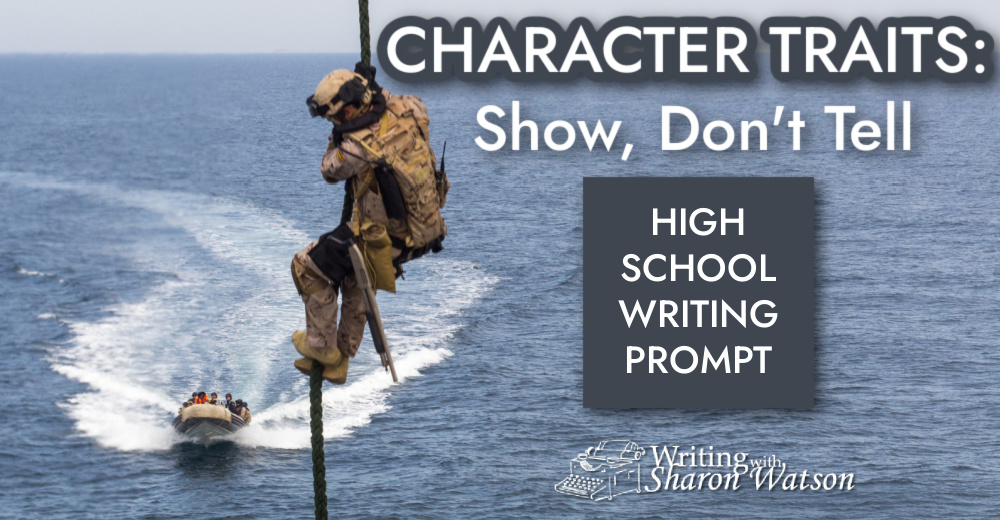
Show, Don’t Tell
When an author wants to let readers know that a character is, say, courageous, she doesn’t write, “Chris was courageous.” Instead, she sets up a situation in which the character has to act bravely, even if he or she feels fearful, showing just how courageous the character is.
Christopher Columbus showed courage by doing something—crossing an ocean when many believed he would fall off the edge of the earth into oblivion.
“Show, don’t tell” is an important element of writing stories. You don’t want to insult your readers by telling them how characters feel or what a character is like. You want to show them by (more…)

by Sharon Watson | Aug 9, 2015 | Literature, Middle School Prompts, Sharon's Blog, Writing Prompts
MIDDLE SCHOOL PROMPTS
It was a common practice long ago that travelers in inns slept in the same bed, even if they didn’t know one another. This seems strange to us and, yes, a little creepy now.
Here is a passage from Moby-Dick by Herman Melville in which the narrator Ishmael is telling us about how he decided not to sleep in the same bed with a harpooneer because Ishmael didn’t know how dirty the guy’s clothes would be (“his linen or woolen”) or even if he could trust him: (more…)

by Sharon Watson | Jun 7, 2015 | Literature, Middle School Prompts, Middle School Tutorial, Sharon's Blog, teaching aids, tutorial, Writing Prompts
MIDDLE SCHOOL PROMPTS
One of the first rules story writers learn is this: Show, don’t tell.
What does that mean? Check out the following examples to see what I mean.
Show It
When you write a story, try not to tell your readers what your character is feeling, like this:
Jeremy was angry.
Instead, show your character in action, like this: (more…)

by Sharon Watson | Jun 7, 2015 | High School Prompts, High School Tutorial, Literature, Sharon's Blog, teaching aids, tutorial, Writing Prompts
HIGH SCHOOL PROMPTS
In a recent tutorial, you practiced plunging your character into hot water with two powerful methods many writers use. You can find that prompt here.
This week you’ll examine three more methods of getting your main character deep into a story. As Stanley Elkin reveals, “I would never write about someone who is not at the end of his rope.” (more…)

by Sharon Watson | May 31, 2015 | High School Prompts, High School Tutorial, Literature, Sharon's Blog, teaching aids, tutorial, Writing Prompts
HIGH SCHOOL PROMPTS
You have an idea for a story but don’t know how to get it going. Or you would like to write a story but are out of ideas.
When you write a story, you have to throw a lot of things at your main character, things he or she would rather not have to deal with. In this prompt, you’ll learn two proven methods to get ideas and plunge your character into hot water. In this prompt, you’ll explore three more. (more…)

by Sharon Watson | Mar 7, 2015 | Literature, Sharon's Blog
SHARON’S BLOG
I’ve had a long and strange relationship with the classics.
In 8th grade, our English class read Nathaniel Hawthorne’s The Scarlet Letter, but I could never figure out what the red “A” stood for.
As an Christian adult, I developed the inexplicable idea that reading fiction was a waste of time. I should read only religious or self-help books . . . until I became so ill that I was bored out of my skull for one month lying on the couch. Then I turned to the only fiction book in our tiny trailer: a complete collection of Sherlock Holmes stories, which seemed appropriate for someone with the last name of Watson.
I was hooked, and I never looked back.
(Well, there was that one time when I resisted reading George Eliot’s Silas Marner because I mistook “Marner” for “Mariner,” and I have a dislike for sea-going stories but then read it and it became one of my FAVORITES! But that is another story.) (more…)