by Sharon Watson | Mar 6, 2015 | Encouragement, Literature, Sharon's Blog, teaching aids
SHARON’S BLOG
Do you have children or students who like to read but don’t have time?
How can you engender a love of reading in your home, even with reluctant readers?
Let’s create an atmosphere in our homes in which reading is not only possible but also enjoyable. (more…)

by Sharon Watson | Mar 3, 2015 | Sharon's Blog, teaching aids
SHARON’S BLOG
Are your homeschool students completely and utterly bored with their writing lessons? Is it a struggle to get them to write again?
.
When it comes to writing essays, it’s easy for students to stall out. They need motivation. They need a change. They need some fun—and so do we!
3 Shocking Tips
Here are three shocking writing tips you can use in your homeschool—shocking because they are fun and because, to your children, they are totally unexpected. (more…)
by Sharon Watson | Nov 30, 2014 | High School Prompts, High School Tutorial, Sharon's Blog, teaching aids, tutorial, Writing Prompts
HIGH SCHOOL PROMPTS
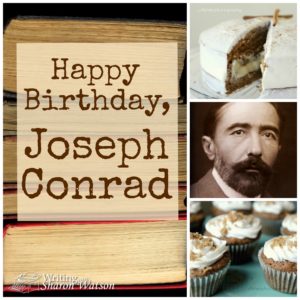 Although author Joseph Conrad was born in Poland as Józef Teodor Konrad Korzeniowski, he learned to speak and write in English in his twenties.
The fact that he learned how to write in the English language so late in life makes his command of the language, as seen in his stories, impressive.
Joseph Conrad is famous for his novella Heart of Darkness in which the narrator goes on a voyage to the jungles of Africa in the late 1800s in search of a man named Kurtz.
Below is the narrator’s description of a scene he comes upon. You can tell by the words and items he chooses in this description that what he finds next will not be nice: (more…)
by Sharon Watson | Nov 9, 2014 | Literature, Middle School Prompts, Middle School Tutorial, Sharon's Blog, teaching aids, tutorial, Writing Prompts
MIDDLE SCHOOL PROMPTS
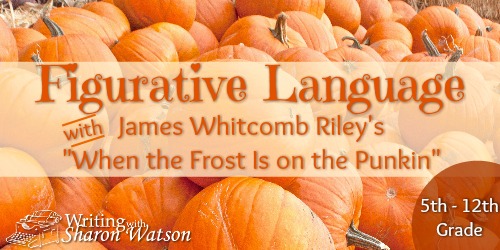
This is a good time of year to read James Whitcomb Riley’s “When the Frost Is on the Punkin,” which you can read here. It describes the glories of life on the farm during the cool, crisp days of autumn, and the harvest season.
In the poem, you’ll find this phrase: “The husky, rusty russel of the tossels of the corn / And the raspin’ of the tangled leaves as golden as the morn. . .”
Note: Riley misspells “russel” on purpose. The correct spelling is “rustle.” Same with “tossels,” which is supposed to be “tassels.” And, of course “punkin,” which is, you guessed it, “pumpkin.” He’s using a country dialect in his writing.
Riley uses the three wonderful words “husky, rusty russel” to describe the sound of the dried leaves of the corn plant as they rub together in the wind. If you have ever heard those dry leaves or blades rubbing together, you can almost hear the “s” sound in the wind, as though they are whispering to each other.
What are Riley’s secrets to writing so well? (more…)
by Sharon Watson | Oct 28, 2014 | High School Prompts, High School Tutorial, Middle School Prompts, Middle School Tutorial, Sharon's Blog, teaching aids, tutorial, Writing Prompts
SHARON’S BLOG
You may be very good at expressing your opinions, especially when you want to change someone’s mind.
What you may not know is that if you truly want to change someone’s mind, you have to stop thinking about your opinion and start thinking about your audience.
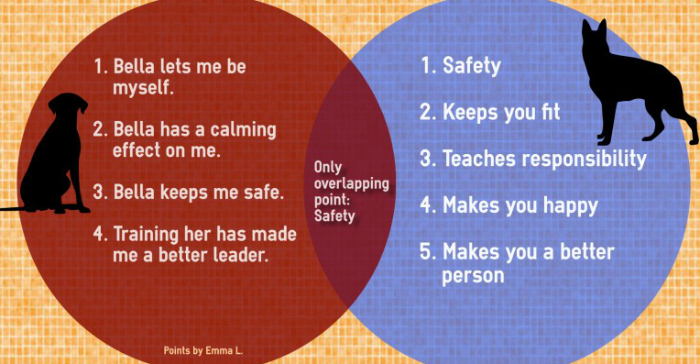
This tutorial, with a free infographic to download, will show you very clearly the difference between writing an opinion and writing to persuade an audience.
Opinion versus Persuasion
Writing or expressing an opinion is all about what you like; convincing another person to do something is all about what they need to hear to be persuaded.
Here’s an infographic that shows the difference between writing an opinion and writing to persuade. After the infographic, I’ve included a short writing exercise you can do quickly. My writing class just did it, and they had fun sharing their ideas about alligators, snow leopards, snakes, and so forth. (more…)
by Sharon Watson | Oct 19, 2014 | High School Prompts, High School Tutorial, Sharon's Blog, teaching aids, tutorial, Writing Prompts
HIGH SCHOOL PROMPTS
Hyperbole is a lot of fun to read and to write.
But what is it?
Hyperbole (hi PER bo lee) is exaggeration, as in “He was as hefty as a whale” or “Her whining voice so electrified the air that it knocked migrating geese off their course.” To read examples of this figure of speech, click here.
Just so you know, this figure of speech is also called a writer’s device and a literary device. And, just so you also know, “writer’s device” and “literary device” mean the same thing. The first is from the writer’s perspective; the latter is from the perspective of a student studying literature.
Here’s an example of hyperbole from Lee Child’s Personal in which he describes one of the bad guys: (more…)