by Sharon Watson | May 24, 2015 | Middle School Prompts, Sharon's Blog, Writing Prompts
MIDDLE SCHOOL PROMPTS
Allan G. Odell saved his company from ruin and made it quite popular.
How did he do it?
In the 1920s, a new shaving product was born called Burma-Shave. It was different from other shaving creams because, now, men didn’t have to lather up some cream or soap with a brush and apply it to their faces for a shave. They simply used this new cream that came in a tube. But the product did not catch on. The company was in trouble.
Then along came Allan Odell with a brilliant marketing scheme. (more…)
by Sharon Watson | May 3, 2015 | Middle School Prompts, Sharon's Blog, Writing Prompts
MIDDLE SCHOOL PROMPTS
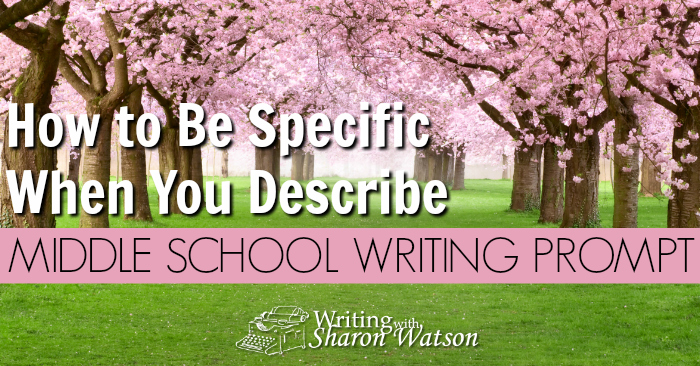
Let’s talk about trees.
Something interesting just happened to you. Right now. This moment.
When you read “trees,” an image of a tree or trees popped into your head. What was it?
When you write to describe something, you want to be specific. You DON’T want to write like this: (more…)

by Sharon Watson | May 3, 2015 | High School Prompts, Sharon's Blog, Writing Prompts
HIGH SCHOOL PROMPTS
So you’re driving your taxi, and someone hails you from the sidewalk. In comes a man you eventually recognize, and you get so excited that you shout a phrase from one of his movies to him.
He laughs and joins in the fun. You drop him off, but that is not the end of the story.
Later, he sends you tickets to his latest Broadway show, and you go and even get to meet with him after the show in his dressing room!
You can read the whole, fun story about the taxi driver “Mr. Ferrari” and the famous actor (more…)

by Sharon Watson | Apr 26, 2015 | Middle School Prompts, Sharon's Blog, Writing Prompts
MIDDLE SCHOOL PROMPTS.
In the mid-1800s, Samuel Morse helped create a code that was used in his new system of communication: telegraphs.
You may be familiar with the Morse code for “SOS”:
· · · ― ― ― · · ·
(or “dot dot dot, dash dash dash, dot dot dot”).
The three dots stand for “S” and the three dashes stand for “O.”
In Frank Gilbreth and Ernestine Gilbreth Carey’s memoir Cheaper by the Dozen, (more…)

by Sharon Watson | Apr 26, 2015 | High School Prompts, High School Tutorial, Sharon's Blog, tutorial, Writing Prompts
HIGH SCHOOL PROMPTS
Today you get to be Shakespeare and write a sonnet.
A sonnet is a poem of fourteen lines. The last two lines, however, are separate and either sum up the rest of the poem or provide a new twist, as does the sonnet below.
Let’s look at Shakespeare’s Sonnet 62. The letters at the end of each line are Shakespeare’s rhyme scheme, but ignore that for now. Take a few moments and read the sonnet. Then I’ll explain it: (more…)
by Sharon Watson | Apr 19, 2015 | High School Prompts, High School Tutorial, Middle School Prompts, Middle School Tutorial, Sharon's Blog, teaching aids, tutorial, Writing Prompts
April is National Poetry Month. What a wonderful time to try your hand at writing a poem!
Haiku (high KOO) is a beautiful poem form that comes from Japan. It is usually about nature and can be spoken in one breath.
Syllables are important in a haiku. Words can be broken into parts based on their vowel sounds. Those parts are syllables. Tree has one syllable. Forest has two. And timberland has three. When you speak these words out loud, you can hear their syllables.
Haiku poems have another feature: They do not rhyme. (more…)